What is Positional Value, and how can it be quantified?
To put it simply, positional value comes down to how important a particular position is to consistently winning football games. For example, while it is important to have a great punter for field position purposes, it would be far better to have the best Quarterback in the league than to have the best punter. Field position is important, but having a signal caller that consistently moves the ball and scores touchdowns is even more so.
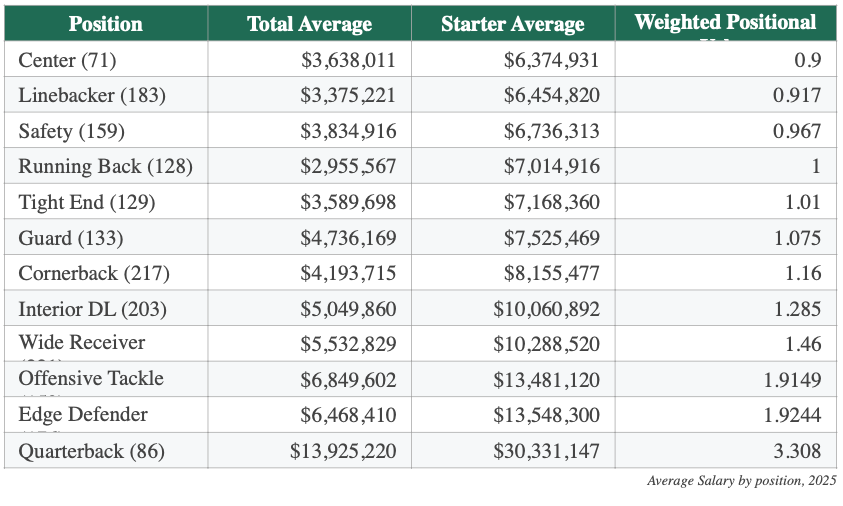
We can see exactly how the NFL values each position by looking at the salaries they are willing to pay each position. In the graph below, we have the average salaries for starters as well as all players at each position for the 2025 season. Using roughly $7 Million/year as the mean, we can see that NFL organizations value a starting QB about 3.3X as much as a starting RB.
It is easy to understand why positional value matters in the NFL, but for the draft, the deeper context can be found in how teams pay rookies. Below is the rookie pay scale for the first 10 picks in the 2026 draft. These contracts include 5th year team options for an extra year of control and come with large signing bonuses.
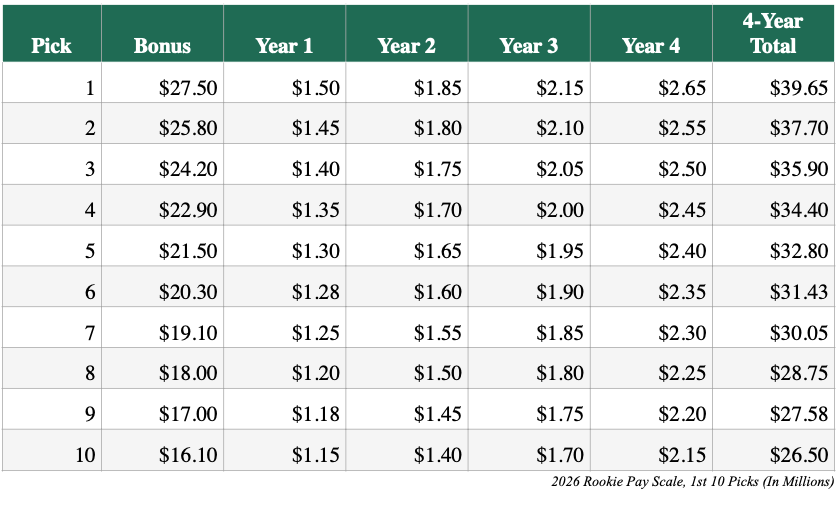
Take Ashton Jeanty for example. He was picked 6th overall by Las Vegas in 2025. When his contract was agreed to, he instantly became the second highest paid running back in the League in terms of guaranteed money. Las Vegas was drafting Jeanty and paying him top tier running back money before he had ever played a snap. This is why positional value in the draft is so important. If a team can use a premium pick to secure a position that normally pays a premium salary, the rookie contract can serve as a way of gaining surplus value on your roster. In Jeanty's case, the Raiders lost surplus value by paying him top tier money so early into his career.
As another example, take Bo Nix and Justin Herbert. Both 1st round picks in the AFC West, both led their teams to the playoffs this year. The difference? Los Angeles paid Justin Herbert $52.5 Million while Denver paid Nix only $4.65 Million. That $48 Million difference is why teams are willing to take a QB in round 1 instead of a safety, running back, or linebacker, no matter how well they grade as a prospect. The surplus value gained from hitting on a premium position outweighs the individual prospect grade.
Do GM's have it right?
When analyzing whether or not GM's have this positional value formula figured out, it is important to note that there is not currently an accurate calculation that exists to fact check our GM's valuations. The closest thing we can do is evaluate Pro Football Focus' Wins Above Replacement (WAR) to draw some interesting insights.
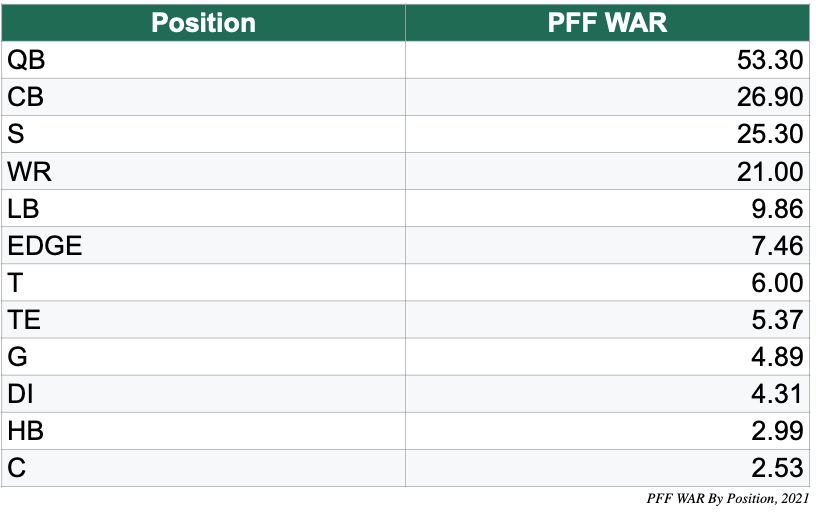
Using this data, it is interesting to show that secondaries contribute far more to PFF's Metric than they are paid, while Edge Rushers are seemingly far less impactful than their perceived value may dictate. So why the misaligned values? It is all about perception. It is easy to see a player on the edge wreaking havoc, creating sacks and living in the backfield. It is harder to notice when a lockdown corner has spent the entire game taking away one half of the secondary.
While WAR may not be a perfect representation of positional value, it is a signal that we may not have the idea down to a science as of yet.
Does Surplus Value have to come early?
Understanding that you will receive surplus value if you hit on a premium position in the draft, is there an argument to be made that you can still receive the same value, just later in a players career? Take for example Derwin James, maybe the best safety in the NFL, is signed for a 4 year deal averaging $19.5 Million/year. Romeo Doubs, an average receiver, just signed a deal worth $17 Million/year. By taking James in the first round of the 2018 draft, the Chargers paid a premium for the safety position relative to the rest of the market. After the expiration of the first contract, the Chargers have been able to retain an All Pro level safety for the price of Green Bay's WR2.
So why are teams overthinking it? I believe it once again comes back to perception, but this time perception of a GM's drafting capabilities. Missing on a 1st Round QB, Edge, or WR can be written off as "Needed gambles" or "Worth the Risk" understanding that hitting on these positions can mean massive savings for an organization. When a GM drafts a Non-Premium position with a premium pick, they have to be so certain the player will be elite as to not draw scrutiny from their owner/fans. GM's also do not have the job security to wait to reap the benefit of surplus value later in a players career. What is the point of drafting a player like Derwin James, knowing he will be valuable for the organization 5 seasons from now, if the GM will not be around to be credited for it? Instead, GM's tend to pick for the best situation at this very moment, gaining value ASAP, therefore extending their own time within the organization.
So, does it even matter?
Without a doubt, there are some positions in football that are more integral to consistent winning than others. Quarterbacks are unequivocally the most important position on the field, and should carry more weight than other positions. That being said, the NFL Draft tends to overhype positional values other than QB while minimizing the rest. There is evidence to say that positions like Edge and WR are overvalued come draft time than positions like Safety and Cornerback. Teams tend to stick to the status quo and try and not stand out when drafting with premium picks.
Our take is simple: The point of the NFL draft is to acquire the best football players possible to lift the overall ceiling of your roster. While it is imperative to hit on premium positions such as QB, we contend that NFL teams are far too worried about positional value in general, and tend to take flyers on worse prospects, simply to fit positional value needs. If I were a GM picking 2nd on Thursday night, Id have Caleb Downs name written on my card in ink at Noon.